2.25-Inch Gravel Tires: When Your Gravel Bike Becomes a Light MTB
The frame list tells you which bikes fit them. This post tells you what actually happens when you run them — and whether it's worth it.
Related: Every Gravel Frame That Fits 2.25" Tires • 45mm Is the New Minimum Gravel Tire
We already covered which frames physically clear 2.25-inch tires. But fitting a tire and riding it effectively are different things. When you mount MTB-width rubber on a gravel frame, you're not just changing tires — you're changing the effective geometry, gearing, and handling character of the entire bike. Here's what actually happens.
The Clearance Reality
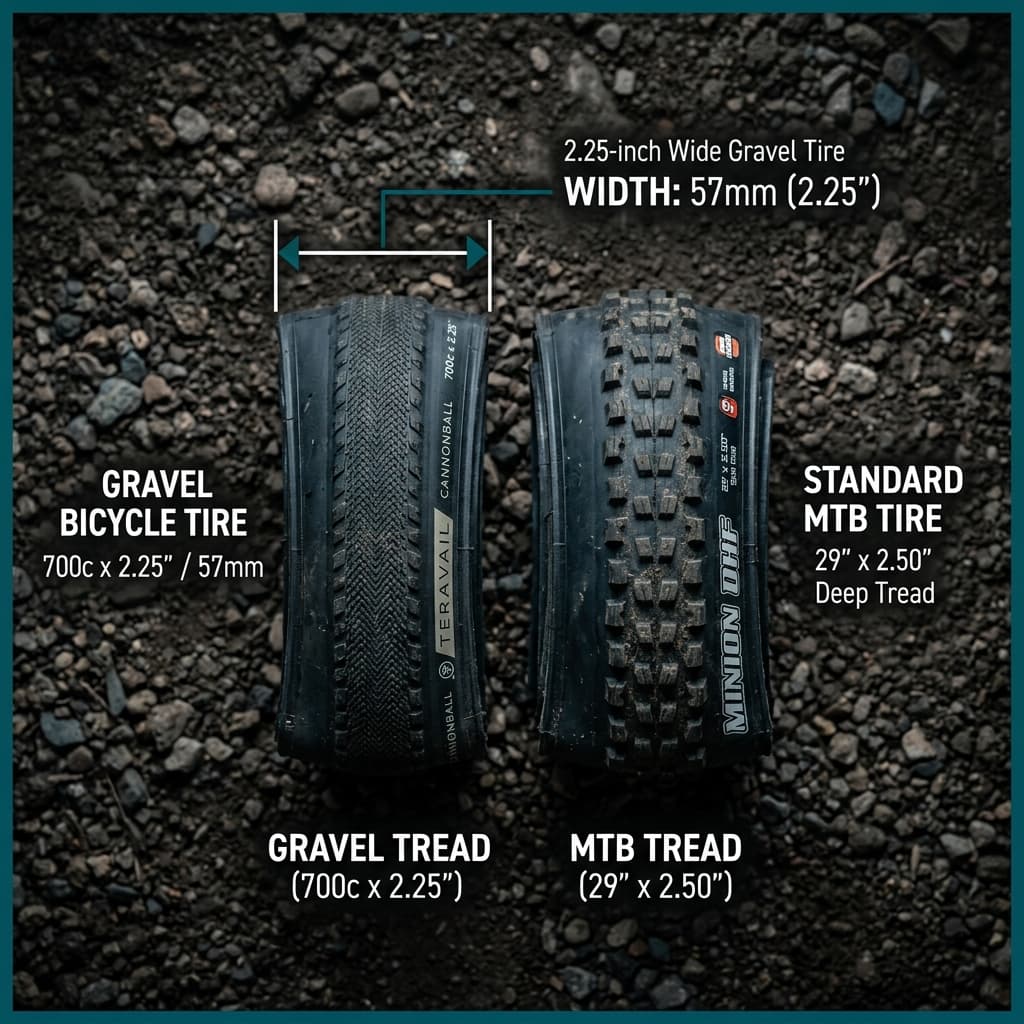
A 700c x 2.25" tire measures roughly 57mm wide when inflated on an appropriately sized rim. That's meaningfully different from the 50mm that most "wide tire" gravel frames accommodate. The gap that matters isn't just the manufacturer's stated clearance — it's the actual inflated width of your specific tire on your specific rim, plus at least 5mm of mud clearance on each side.
Tire casings vary significantly between brands. A nominally "2.25-inch" tire might measure 54mm on a 25mm internal rim or 59mm on a 30mm internal rim. Run the same tire on too-narrow rims and it grows taller, not wider — and that's where you run into crown and chainstay clearance issues even on frames rated for 2.25".
Real Clearance Numbers for 700c x 2.25"
| Internal Rim Width | Inflated Width (approx.) | Clearance Needed |
|---|---|---|
| 21mm (too narrow) | 55-56mm tall, narrow | 61mm+ |
| 25mm (minimum) | 57-58mm | 63mm+ (incl. mud) |
| 28-30mm (optimal) | 58-60mm | 65mm+ (incl. mud) |
Always measure your actual inflated tire before assuming nominal specs apply.
The Gearing Math You Can't Ignore
This is the part most tire-width discussions skip entirely. A 700c x 2.25" tire has a circumference of approximately 2,325mm. A 700c x 40mm tire has a circumference of roughly 2,170mm. That's a 7% difference in rollout per pedal revolution.
In practice, this means:
- A 34t chainring with 2.25" tires feels like a 36.4t chainring with 40mm tires
- Climbing in your easiest gear (e.g., 34x46t) now gives you 7% fewer pedal strokes per vertical foot
- Top-end speed increases slightly — but that's rarely the concern at 2.25" widths
Effective Gear Inches: 34t Chainring Comparison
With 40mm tire
34t × 46t = 19.7 gear inches
34t × 11t = 82.4 gear inches
With 2.25" tire (+7%)
34t × 46t = 21.1 gear inches
34t × 11t = 88.2 gear inches
Use CrankSmith's drivetrain lab to calculate your exact effective gearing with any tire size.
The fix is simple: drop your chainring size. If you were running a 34t ring with 45mm tires and climbing felt right, consider a 32t with 2.25" tires to restore the same climbing ratio.
Geometry Shifts
Wider, taller tires do change how a gravel bike handles — but not in the ways people expect. The real changes are:
- Bottom bracket height increases slightly — more tire volume means the BB sits fractionally higher relative to ground. On a gravel bike with an already high BB (for ground clearance), this is rarely noticeable but reduces the planted feel at low speed.
- Effective wheelbase grows marginally — wider tires deform into an oval contact patch. The center of the contact patch moves very slightly rearward. Imperceptible in practice.
- Trail changes negligibly — unless you're running a different tire diameter (700c vs 650b), the steering geometry stays mostly intact.
- Handling at speed is different — 2.25" tires require more input to change direction than 45mm tires. Not sluggish, but deliberate. At gravel speeds this is rarely an issue. On pavement it feels like riding a different category of bike.
Who Actually Should Run These?
This setup isn't for everyone — or even most gravel riders. It makes real sense for:
Good fit ✓
- Bikepacking on mixed terrain (jeep roads, singletrack, gravel)
- Events like Crusher in the Tushar, Dirty Kanza XL — technical, variable surfaces
- Riders who own one bike and ride trails casually on weekends
- Loaded touring where volume and stability matter over speed
Poor fit ✗
- Race-focused gravel (weight penalty, added rolling resistance on gravel)
- Primarily road/tarmac riding
- Frames with less than 57mm clearance (clearance will be dangerously tight)
- Anyone who needs fine gearing steps over raw climbing range
The Bottom Line
Running 2.25" tires on a gravel bike is a legitimate and increasingly popular choice for adventure riders who want one versatile bike. But it requires matching components: a wide enough rim (25mm+ internal), a frame that actually clears the inflated tire with mud room, and a smaller chainring to compensate for the taller gearing. Get those three things right, and it works brilliantly. Skip any one of them and you'll be trimming tire sidewalls or spinning out on climbs.
Before you commit, check your frame's actual clearance against your specific tire brand and rim width combination. CrankSmith does this automatically when you enter your build — it flags potential clearance conflicts based on real casing dimensions, not just nominal sizes.