Gravel Axle Standards: Boost, 142×12, and Why Thru-Axle Size Matters
QR is dead. 142×12 is standard. 148×12 Boost is creeping into 2026 gravel frames. Here's what that means for your hub and wheel choices.
Reference: CrankSmith Axle Standards Reference Page
Axle standards affect hub compatibility, wheel stiffness, and — indirectly — tire clearance. Understanding them is essential when buying wheels for a gravel build, spec'ing a replacement hub, or evaluating frame options. Here's the complete picture for 2026.
The Evolution: QR → Thru-Axle → Boost
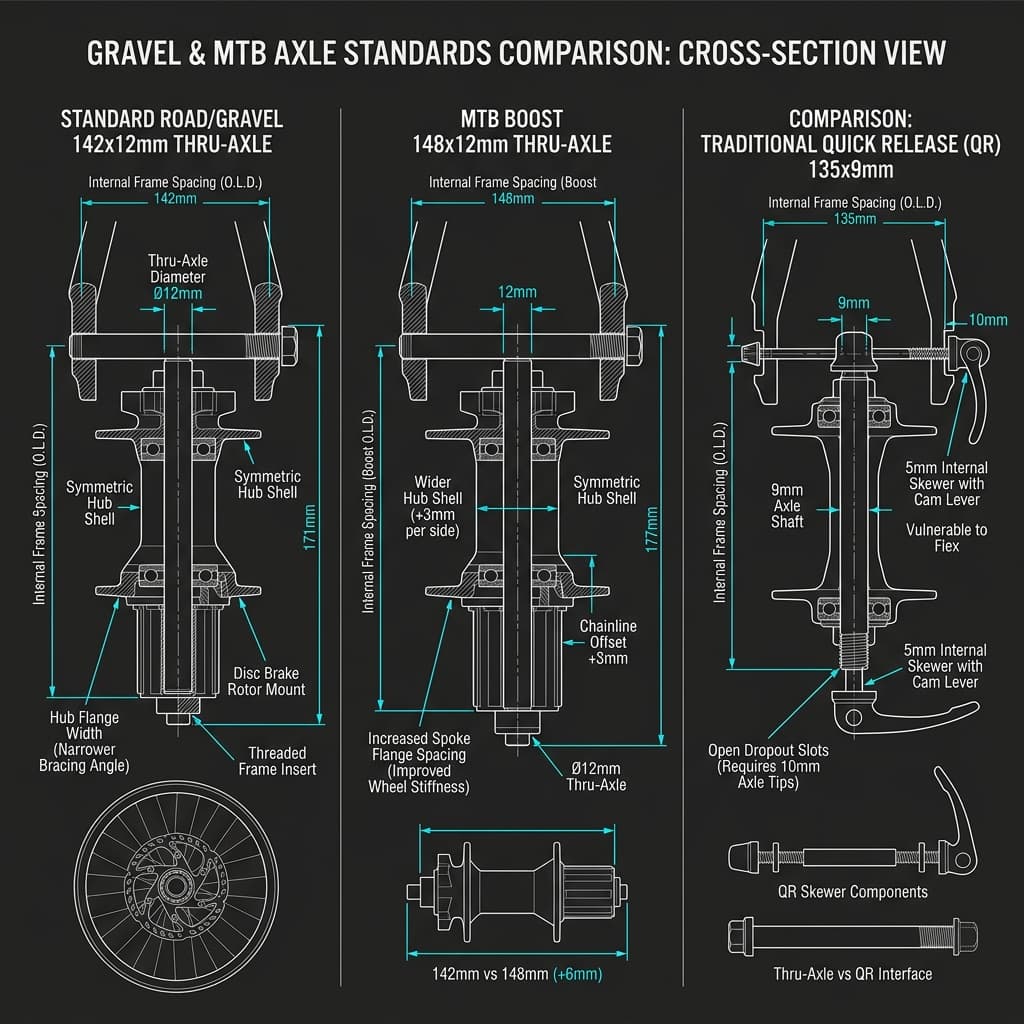
Quick release (QR) used a 5mm skewer through a hollow axle in cup-and-cone dropouts. It worked fine for decades on road bikes but introduced flex under the lateral loads of disc brakes. The industry shifted to thru-axle because a solid 12mm shaft locks directly into closed dropouts, virtually eliminating flex under braking.
Rear Axle Standards — Quick Reference
| Standard | O.L.D. | Axle Dia. | 2026 Usage |
|---|---|---|---|
| Quick Release | 130/135mm | 5mm skewer | Dead for gravel |
| 142×12 Thru-Axle | 142mm | 12mm | Standard gravel |
| 148×12 Boost | 148mm | 12mm | Adventure/gravel+ frames |
| 157×12 Super Boost | 157mm | 12mm | MTB only, rare gravel |
Why Boost Is Appearing on Gravel Frames
Boost (148×12mm) moves each hub flange 3mm further outward compared to 142mm. The practical consequences:
- More wheel stiffness — wider flange spacing improves spoke bracing angle. A 148mm Boost wheel is laterally stiffer than an equivalent 142mm build, all else equal.
- Wider tire clearance potential — the chainstay shape that accommodates 148mm spacing often also provides more room for wider tires. Not automatic, but common.
- Better chainline for 1x — the Boost offset shifts chainline outward, which suits 1x drivetrains and MTB-derived cassettes (useful for mullet setups).
The trade-off: a 148mm Boost frame requires 148mm Boost-specific hubs. You can't put a standard 142mm hub in a 148mm dropout — the axle won't reach both sides. Some hubs (DT Swiss 350, Hope Pro 5) offer conversion end caps, but this is the exception, not the rule.
Front Axle: Almost Always 100×12mm
Front forks on gravel bikes are almost universally 100×12mm thru-axle. The threading is typically M12×1.0mm or M12×1.5mm — check your fork specification before buying a replacement axle. Some brands (Specialized, Canyon) use proprietary axle heads. Front Boost (110×15mm) exists on some MTB-origin forks but is rare on purpose-built gravel forks.
Hub & Frame Compatibility Summary
Standard gravel frame (142mm)
142mm O.L.D. hubs required. Any standard road/gravel hub.
Boost gravel frame (148mm)
148mm Boost hubs required. Or DT Swiss/Hope with Boost conversion end caps.
Flip-chip frame (142/148mm)
Check which mode before buying. Typically ships in 142mm mode.
For the full compatibility table including freehub standards (HG, XD, Micro Spline) by axle standard, see the CrankSmith Axle Standards Reference.